-
The diffuse ways we develop IT skills may mean that traditional models of literacy and skills development are ill-suited to the natural, and rapid, evolution of IT skills.
-
The Spring 2000 issue of the Journal of Palliative Medicine, published by Mary Ann Liebert, Inc., marks the debut of the print version of Innovations in End-of-Life Care, EDC’s online journal for health practitioners caring for dying patients and their families.
-
Through community service, students discover they can make a difference in the world around them.
-
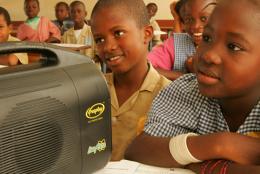
In our 40-year history of curriculum development, we’ve learned that designing good hands-on activities often means more than writing a sound lesson plan. Sometimes you also have to design innovative materials to put in the hands of learnersor, better yet, let the learners design the materials themselves.
-
About 65,000 U.S. patients are waiting for transplantskidneys, hearts, livers, and lungsto save or improve their lives. More than 4,000 patientsor 12-13 each daywaiting last year died because of the critical shortage of transplantable organs.
-
Beyond simple descriptions, well-developed skill standards provide a common language for employers, educators, and current and future workers in a wide variety of industries.
-
As Lucia Gliga describes it, the traditional Romanian approach to teacher education was very straightforward: "If you were good at a subject, you would be a good teacher."
-
Carlo, a New York seventh-grader, had composed several questions for an interview his class would conduct with a local cardiologist. He and his classmates were preparing the interview for their social studies class, but they had composed the questions in science class and role-played the interview in language arts.
-
Elegance. Culture. Habits of mind. Such phrases are usually reserved for literature, philosophy, or fine arts. But in the case of EDC’s newest curriculum, they describe geometry. While covering the basics of high school geometry, Connected Geometry discusses ways to build elegant bridges among mathematical ideas, create a lively culture of mathematical investigation, and develop students’ abilities to inquire and think.
-
In the summer of 1960, reverend Solomon B Caulker, an African college administrator from Sierra Leone, travelled to Israel to attend an international conference on improving science education in developing countries. After listening to several papers on nuclear power, Caulker stood up to address the group.
-
Toward the end of the Live Talk discussion program that opened EDC’s recent violence prevention summit, the audience of 200 people grew silent as Sha-King Graham, 17, spoke about the police officer who had killed his sister.
-
After RAP, the longest-running EDC project comprises our largest body of equity work: the Women’s Educational Equity Act Resource Center (WEEA). For more than two decades, the WEEA Resource Center has developed, published, and distributed innovative, gender-fair materials to teachers and education leaders around the country.
-
When Eleanore Grater Lewis began teaching, more than 40 years ago, it was very unusual to see a child with disabilities in a preschool classroom. “In those days, children with disabilities were largely excluded from any sort of preschool experience,” she explains. “Basically there were two options: Either they stayed home or they were institutionalized.”
-
Today, thanks to the efforts of EDC, 20 Latina mothers from Waltham, Massachusetts, are enrolled in a class that offers them not only English language instruction but also lessons in job readiness, social skills, community action, health, and self-esteem.
-
When adolescents have an opportunity to contribute and to be depended on, they can transform their lives, reinvigorate their education, and touch the lives of many in their communities. And a new EDC study has shown that some community service projects may directly benefit teenagers’ health.
-
Written for public health practitioners and students, Injury Prevention and Public Health: Practical Knowledge, Skills, and Strategies works from the premise that in most cases “injury is not an accident”—not the result of unpredictable or unavoidable occurrences. Instead, most injuries are foreseeable events with known causes and risk factors—and are therefore preventable.
-
The staff of EDC’s K-12 Mathematics Curriculum Center at EDC likes to think of their new book, Choosing a Standards-Based Mathematics Curriculum, as the “eyes, yardsticks, and noses” schools will use to evaluate and select a mathematics program that fits their needs.
-
From the dry, wind-burned Andean villages where the altitude thins the air and turns the land to dust to the lush Amazon jungle regions of Bolivia, the educational story is often the same: the opportunities for learning are reduced by isolation and the demands of daily life. Thirty-eight percent of children under five suffer from malnutrition, which is associated with four out of five deaths in young children.
-
Al Cuoco, director of EDC’s Mathematics Initiative, and EDC Vice President Wayne Harvey, a mathematics education researcher, emphasize that improving mathematics education goes beyond a simple choice between traditional mathematics and mathematics based on the NCTM standards.
-
Community-based technology centers narrow the "digital divide" between the technology haves and have-nots by providing computer access and education to the unemployed and working poor, according to a National Science Foundation (NSF)funded report released this month.
-
Al Cuoco might have added that there are things kids need to understand about mathematics that do not show up on the traditional mathematics tests. And that touches on a particularly difficult issue for mathematics educators today: How can we evaluate students’ understanding of mathematical methods and concepts as well as their command of specific skills? What new tools and strategies do we need? And what roles should teachers play in employing these tools and strategies?
-
In a large conference room, several groups of adults gather around an assortment of batteries, copper wires, and light bulbs. Their task is to discover how many different ways they can illuminate the bulbs using only this rudimentary electrical equipment.
-
A coalition of educators committed to supporting excellence in teaching, NBPTS has established nationwide teaching standards at all levels of preK-12 education. In 1994, NBPTS contracted with the Center for Children and Families (CC&F) at EDC to design, field-test, and implement an assessment process for early childhood teachers.