-
Frustrated with the standard lecture approach to mathematics, teachers have developed a hands-on, interactive lesson that uses the relative heat of chili peppers to introduce and explore the mathematics concepts of properties and logarithms.
-
If you walk into Peg Clapham’s third grade class at the Healy school in Somerville, MA on Tuesday mornings, you will see children making geometric quilt designs and talking math.
-
For children with terminal illnesses, sometimes small details in how they’re cared for can make a huge difference. In a new EDC video created to improve the care of seriously ill children, a young boy describes his frustration when he can’t get a nurse to move an IV stand that prevents him from holding his mother’s hand. “Why wouldn’t the nurse listen to me?” he wonders.
-
Is it bad for parents to talk "baby talk" to their babies? How can you tell if a first grader is behind in reading? Is it normal for a child to talk to herself? Is it okay to read the same books every night? Parents with these and other questions about a child’s reading and writing can now "Ask the Expert" by logging on to the PBS Parents Web site.
-
Only 37 percent of America’s institutions of higher education report sexual crime statistics in full compliance with federal law.
-
In the hours following the terrorist attacks of Sept. 11, crisis responders fanned out across the country, bringing help, compassion, and solace to survivors and families of victims. Some professional volunteers drove several hundred miles to assist survivors; all put their lives on hold. Many of the volunteers were organized by the National Organization for Victim Assistance (NOVA), which held a conference in April to honor the survivors and victims of the tragedy and to identify the lessons that could be learned from the experiences.
-
Funded by the International Committee of the Red Cross and developed by EDC, EHL is a rich investigation of International Humanitarian Law for secondary school students. It is currently in use in more than 55 countries worldwide, including those experiencing active conflicts, such as Israel, the Palestinian National Authority, Northern Ireland, and the former Yugoslavia.
-
As one of an estimated five million living Americans who have attempted suicide, Susan Rose Blauner discussed her struggle with the feelings and fantasies surrounding suicide and her search for help.
-
Over the past several years, a number of educators and school districts have experimented with different models of online professional development (OPD)Web-based courses designed to supplement or take the place of face-to-face workshops. However, little is known to date about the impact of OPD offerings on students, classrooms, and schools.
-
Two days after September 11th, EDC Vice President Eric Jolly began talking to colleagues about what the organization could do to support teachers as they helped students make sense of the tragedy and its aftermath. Newspapers were beginning to carry reports of violence against Muslims and people who appeared to be of Middle Eastern descent. Recalls Jolly, “Obviously, we couldn’t do anything about the violence that had already taken place, but we thought we could help prevent attacks against new groups of innocent victims—including Arab Americans.”
-
When students who will be entering the New Bedford Global Learning Charter School this fall sat down earlier this summer to have their literary skills assessed, they were providing information that will help shape curriculum and teachers’ professional development at this new school set to open its doors in September.
-
A six-school nutrition pilot project in China offered to more than 8,000 school staff, students and their families has produced significant improvements in their knowledge, attitudes, and behaviors, promoting optimism that the approach could benefit schools throughout China and around the world.
-
Teachers from across the Everett, Washington pathway meet weekly in faculty study groups to tackle a variety of topics in teaching and learning. The study groups have taken different forms as they’ve evolved over five years, but they are all driven by student and teacher needs and interests.
-
Like most principals facing a new school year, Carol Stack, at the Jefferson Middle School in Champaign, Illinois, had set a series of goals for herself in September of 1999. One of her top goals was to reduce the school’s suspension rate. She had a hunch that particular groups of students were being suspended in disproportionate numbers, but she didn’t have a firm handle on the scope of the problem.
-
On the East Side of Pittsburgh, Vonnie Holbrook is known as “the math lady.” A teacher in Pittsburgh for 24 years, she has taught mathematics in many schools and to many children from kindergarten to eighth grade.
-
Much of our understanding of the relationship between technology and school reform grows out of more than 10 years of collaboration and partnership with the Union City Public Schools.
-
Some researchers approach schools with a certain level of arrogance: ‘We know what’s right, and we think we’ll make your lives better if only you’ll let us.’ It’s well intentioned but it’s very misguided. We have a different mindset at EDC; we hold firm to the notion that our collaborations need to be done in partnership and that our work is not about importing knowledge into a district.
-
Education researchers and developers know a great deal about the systemic variables involved in sustaining school reform—such as assessment and alignment, leadership, curriculum.
-
In a classic sense, what people mean by sustainability is that they are going to preserve what they have. In our work with the Carpe Vitam Foundation, we prefer to say that we want to conserve, not preserve. We have trademarked the term ‘open architecture’ to describe that process.
-
It became clear early in the RSR study that we needed to ask ourselves, What exactly do we mean by sustainability? When a community has a program in place for 20–plus years, it isn’t the same program that started some 20 years ago, nor would we expect or want it to be the same program. How and why has it changed?
-
When Egypt’s Ministry of Education set out to increase the number of rural girls attending elementary school, it had to begin with the basics-building more classrooms. Because the schools in the Egyptian countryside have traditionally been large, overcrowded, and located a good distance from village centers, the Ministry, together with USAID and CARE/Egypt, has opted to build new, smaller schools in the rural villages.
-
The GE Fund today released a new study that documents obstacles and solutions for improving minority and female student performance in pursuing careers in science, engineering, and technology (SET). Upping the Numbers, co-authored by EDC and Campbell-Kibler Associates, is one of the first studies to gather data on what really works to increase under-represented students’ interest and success in these fields.
-
In 1999, Jeanne Century and her colleagues in EDC’s Center for Science Education set out to explore Tyack and Cuban’s provocative question in unprecedented depth. They identified elementary science programs in nine districts across the country that had been in place for a decade or more.
-
In 1996, Cathy McCarthy was a brand new principal at the Armory Street School in Springfield, Massachusetts, when she received word that the elementary school’s test scores were among the lowest in the city. The staff was stunned, but McCarthy saw the bad news as an opportunity to spur widespread changes in the school. She just wasn’t sure where to begin.
-
New and emerging technology tools have a vast potential to make educational materials and programs accessible to many more students, provided the tools are designed with the broadest possible range of students in mind. That approach-called "universal design"-should be codified into federal law, according to EDC’s Center for Children and Technology (CCT) and a coalition of partners.
-
In the book The Diagnostic Teacher: Constructing New Approaches to Professional Development, EDC researchers Mildred Z. Solomon and Catherine Cobb Morocco contrast traditional models of professional learning for teachers with standard practice in other professions.
-
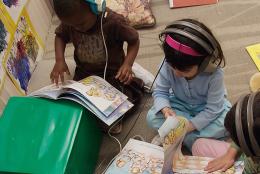
How can teachers create an environment that engages even their most challenging children? How can they foster children’s ability to think scientifically as part of their everyday experiences? How can they improve young children’s literacy skills, not only in the book corner, but throughout the day?
-
A “campus mystery,” an interactive Web site, and interesting “factoids” were the ingredients of one campus’s innovative and successful social norms campaign to reduce problem drinking. EDC’s Higher Education Center for Alcohol and Other Drug Abuse and Violence Prevention(HEC) has recently published a case study that describes the initiative, Multifaceted Social Norms Approach to Reduce High-Risk Drinking: Lessons from Hobart and William Smith Colleges. Written by H.
-
College students consistently overestimate how much their peers are drinking, according to many research studies. In turn, that widespread misperception encourages some students to drink more to “keep up” with the majority of their peers. Would students drink less if they had more accurate information about the campus “norm?”
-
Hosted and moderated by EDC’s Global Learning Group, the GKD List is a unique virtual learning community that brings together technology specialists from every region of the world to discuss innovative uses of information and communication technology (ICT) in support of sustainable development.