Home
Skip to Navigation
  • ABOUT EDC
    • Brochures
    • Contracting with EDC
    • EDC Board of Trustees
    • EDC Leadership
    • Fact Sheet
    • FAQ
    • Funders
    • History
    • Job Opportunities
  • |
  • DIVISIONS
    • Health & Human Development
    • International Development
    • Learning & Teaching
  • |
  • NEWSROOM
    • Articles
    • Commentary
    • Media Coverage
    • Press Releases
  • |
  • PUBLICATIONS
  • |
  • RESEARCH & PROGRAM AREAS
    • Building Communities
    • Improving Schools
    • Integrating Work & Learning
    • Promoting Health
    • Supporting Children & Families

Home / Newsroom

Articles

Each month, EDC posts several new feature articles. This page provides an archive of past articles, including reports of emerging research and profiles of new EDC publications and Web sites.
  • Turning to the Evidence

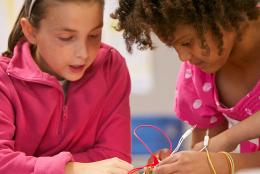
    The last decade has seen a boom in the use of “manipulatives” in K–8 mathematics classrooms. Teachers around the country are using cubes, pattern blocks, tiles, and other hands-on tools to make mathematical concepts more engaging and concrete for students. The trend has spread even without much research that demonstrates why, how, or if manipulatives work.

  • Exploring Interconnections Among Risky Behaviors

    Violence, substance abuse, unprotected sex, and related risky behaviors take a tragic toll on the lives of individuals and their communities. To prevent these risks, we must first understand the factors and circumstances that contribute to risk-taking. EDC’s Center for Research on High Risk Behaviors (RHRB) conducts a variety of research projects that develop, evaluate, and disseminate effective interventions for reducing health risks.

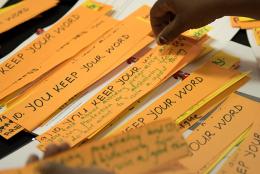
  • Using Classroom Artifacts in Teacher Professional Development

    A dozen middle and high school teachers seated around a U-shaped table are scrutinizing stacks of papers spread out before them. The papers include a math problem that one of the teachers’ classes worked on the previous week, copies of student work on the problem, and a transcript of the classroom conversation among one group of students. EDC’s Mark Driscoll stands at the center of the U, leading the teachers through a careful analysis of the “artifacts” before them.

  • Online Professional Development

    Online professional education for teachers and administrators has been a rapidly expanding industry over the past several years. Educators and districts across the country have been drawn to the convenience provided by online courses and workshops. But how effective are these courses, and what features determine the success of an online offering?

  • Up Close with Mildred Z. Solomon, EDC Vice President

    Dr. Mildred Solomon directs EDC’s Center for Applied Ethics and Professional Practice. The center researches the complexities associated with advances in medical knowledge and technology, and designs programs aimed at improving clinical practice, health care decision-making, and, ultimately, patient and family well-being. She was recently named to the U.S. Department of Health and Human Services Secretary’s Advisory Committee on Transplantation, which advises the Secretary on national organ donation policy.

  • Promoting Youth Leadership in Gaza and the West Bank

    For years, Palestinian youth living in the West Bank and Gaza have seldom been perceived as an important resource for building their nation’s future. The Palestinian Youth Empowerment Program, or RUWWAD, is hoping to change that perception.

  • Keeping Teens Safe at Work

    Most of the 80 percent of teens who work enjoy a positive and enriching experience. However, teenagers in the workplace may be at risk for injuries on the job due to inadequate safety training, unsafe equipment, and stressful environments.

  • EDC Teams with Cisco Systems to Target IT Gender Gap

    EDC’s FunWorks project has teamed up with technology giant Cisco Systems, Inc., and the National Center for Women & Information Technology to increase awareness of education and career opportunities for girls and women in math, computing, and technology.

  • Newsletter Focuses on Emergency Preparedness on Campus

    Reinforced by the impact of Hurricane Katrina on New Orleans colleges, U.S. campuses are taking more deliberate approaches to planning for emergencies, including accidents, epidemics, natural disasters, violent incidents, and terrorist attacks.

    In line with these efforts, emergency preparedness on campus is the focus of Catalyst, a 12-page newsletter recently published by the U.S. Department of Education’s Higher Education Center for Alcohol and Other Drug Abuse and Violence Prevention (HEC). The center is operated by EDC’s Health and Human Development Programs.

  • Radio Brings Information, Resources to War-Ravaged Sudan

    With funding from USAID, EDC’s International Education Systems Division is using radio to bring vital information and resources to the poorest and most remote regions of Sudan.

  • Web Site Offers Teachers Creative Literary Resources

    Teachers know that the Internet is full of useful and creative materials to improve reading, but often they are too busy to find the best ones. To make these Web resources more readily available, Judith Zorfass and her staff at EDC’s Center for Family, School, and Community have developed the Literacy Matters Web site. The site aims to improve the literacy development of middle and high school students, especially those who may be struggling.

  • Online Math Training for Military-Base Schools

    The Department of Defense Education Activity operates 200 schools in 13 countries that enroll more than 100,000 students—the children of military service members and Department of Defense civilian employees. EDC is providing online training and materials to nearly 3,000 teachers who work in these schools.

  • Instructional Coaching for Teachers

    More than 200 educational leaders from across the country gathered in Boston last September for a three-day conference focused on a particularly promising school improvement strategy.

  • EDC Program in Uruguay Goes Beyond "No Smoking"

    After successfully piloting its youth tobacco control program in India, Ghana, and Mexico, EDC’s Health and Human Development Programs is now testing the model in Uruguay. The country, emerging as a leader in tobacco control efforts in Latin America, was one of the first in the region to ratify the international Framework Convention on Tobacco Control.

  • Promoting Healthy Learning in Germany

    EDC is collaborating on a ground-breaking program in Germany designed to improve education by attending to the physical, social, and mental health of teachers and students, as well as the quality of the learning environment.

  • Discovering Nature in Chinese

    Discovering Nature with Young Children, one of three curriculum modules in the Young Scientist series published by Redleaf Press, has now been translated into Chinese.

  • EDC Hosts Education Tour for Egyptian Delegates

    EDC’s International Education Systems Division recently hosted a study tour for 15 Egyptian education experts who are working with the Egyptian Ministry of Education to reform early childhood education. The tour, conducted in partnership with the Academy for Educational Development, was funded by USAID and focused on best practices in early childhood care and education training.

  • EDC and PBS Promote Childhood Creativity

    The home computer can become an electronic babysitter for busy parents, but educators believe that young people learn best when parents participate in their children’s “screen time.” Toward that end, EDC has developed a Web site featuring online activities for parents and children (to age 9) to do together. “The site is designed so parents can see their child’s creativity in action,” says Christine Rafal of EDC’s Center for Children & Families. “It’s meant to help parents learn more about their child’s creative development.”

  • EDC's Afghanistan Project Develops Literacy, Empowers Communities

    Many Afghans who grew up during decades of war and repressive rule are now in their twenties, struggling to find their footing in a dramatically altered and rapidly changing country. Deprived of the opportunity for schooling in their early years, many are unable to read; some can’t even recognize letters of the alphabet. In rural areas, about 70 percent of heads of households cannot read or write.

  • A New Start for Out-of-School Teens in Haiti

    EQUIP3/Haitian Out-of-School Youth Livelihood Initiative, or IDEJEN as the project is known locally, operates twelve youth centers. Each center provides 50 students between the ages of 15-20 with an education in basic reading, writing, and mathematics. Students also receive lessons in health, nutrition, conflict-resolution, and other life-skills. In addition, they learn a marketable trade such as sewing, woodworking, auto mechanics, handcrafts, hotel services, or agricultural businesses.

  • Remembering Marilyn Felt

    Marilyn Clayton Felt had a commitment to social justice and equity that found expression in her work as a researcher, curriculum designer, and playwright. A long time member of EDC’s staff, Felt died last week of cancer at the age of 68.

    “At the age where most people would retire, she was just in the middle of her career,” said her husband, George Lukas.

  • Boys and girls in Maridi, Sudan participate in a formative SSIRI evaluation class.

    Interactive Radio Instruction

    As Sudan works its way toward peace and reconstruction, the Ministry of Education, Science and Technology and USAID have turned to the task of building the region’s first viable education system.

  • EDC's Teen Dating Violence Curriculum Hailed by U.S. Senators

    Responding to new data that reveals “deep and troubling” findings about dating abuse among U.S. teens, Senators Mike Crapo and Hillary Rodham Clinton are joining with Liz Claiborne Inc. Chairman and CEO, Paul R. Charron to announce the national distribution of the curriculum, Love Is Not Abuse, developed with EDC. The program is designed to help teens understand and prevent teen dating abuse and violence. During the week of April 24th, Love Is Not Abuse will be taught in over 365 schools in 37 states reaching more than 33,000 students.

  • Youth Risk Behaviors

    Adolescents living in high-poverty urban settings face complex challenges to their health and futures.

  • High School Science

    What caused the Hindenburg to explode in 1937? What happens if a runner drinks too much water during a long race? How do you determine if an envelope with a powdery white substance contains anthrax? These are some of the questions that ninth grade chemistry students wrestle with in Foundation Science, a new high school science curriculum developed by EDC.

  • Students sign on to support the WHO project during a mobilisation meeting at Shu Ghang Middle School in Ningbo.

    Health-Promoting Schools in China

    The concept of health-promoting schools is taking hold in China, according to EDC’s Carmen Aldinger, project director in HHD (Health and Human Development Programs) Global Programs, who recently returned from an evaluation visit for the Health-Promoting Schools (HPS) project in China’s Zhejiang Province.

  • Technology Implementation in Macedonia

    Information and communication technologies (ICTs), if appropriately deployed, can bring about new and innovative teaching and learning practices among educators and students. dot-EDU’s E-School project in Macedonia is pioneering uses of ICT for improved teaching and learning—and is demonstrating quantifiable impact.

  • EDC Offers Second National Event on Instructional Coaching

    More than 200 educational leaders from across the country gathered in Boston last September for a three-day conference focused on a particularly promising school improvement strategy. The “Instructional Coaching Conference,” organized by EDC’s Center for Leadership and Learning Communities (CLLC), featured success stories from several large urban districts across the country that have hired full-time coaches to provide ongoing professional development to teachers.

  • SRS producers speak with the head of the Southern Sudanese government.

    Sudan Radio Service

    Struggling to emerge from decades of civil war, the people of Sudan are working to rebuild their society. With funding from USAID, EDC’s International Development Division (IDD) has developed Sudan Radio Service (SRS), the first independent and unbiased radio service to reach across the country with accurate news and information.

  • Tsunami Relief

    Health and Human Development Programs’ (HHD) Southeast Asia Initiative has developed a new education project for youth in four Thai ‘sea gypsy’ communities the village hardest hit by the tsunami. Funding from Deutsche Bank will permit HHD to offer life skills, vocational training, market research, and formal education assistance.

  • « first
  • ‹ previous
  • …
  • 12
  • 13
  • 14
  • 15
  • 16
  • 17
  • 18
  • 19
  • 20
  • …
  • next ›
  • last »
  • Articles
  • Commentary
  • Media Coverage
  • Press Releases


  • Job Opportunities
  • Accessibility Statement
  • Credits
  • Directions
  • Contact

© 1994 - 2013 Education Development Center, Inc. All Rights Reserved.

Education Development Center, Inc.
43 Foundry Avenue Waltham, MA 02453-8313, USA

Boston - Chicago - New York - Washington, DC