-
A new multimedia CD and Web site captures EDC’s six-year, 30-country technology initiative that expanded and deepened learning around the world. Since 2001, the program—known as dot-EDU—has worked with communities to implement a variety of information and communication technology programs. The presentation examines common themes and lessons learned, and also highlights specific technology applications and the impact they can have.
-
In Zambia, teachers are using iPods to enhance professional training in mathematics, science, and English.
-
Andrea Osborne-Smith, program manager for EDC’s education initiative in Indonesia recently returned from Aceh, the remote region ravaged in the tsunami of 2004. Andrea was there to train kindergarten teachers to use EDC’s interactive audio programs. The lessons, developed with local educators, weave songs and stories into literacy and numeracy instruction. She spoke with us from her office in Jakarta.
-
When students play with TinkerPlots, the colorful software program, they can instantly turn numbers into graphs. Using dot plots, pie charts, scatter plots, histograms, and images of their own creation, students can see patterns and analyze data that might have otherwise been obscure. A new book by EDC, Digging into Data with TinkerPlots, gives students in grades 6–8 hands-on activities to explore data, make conjectures, create and interpret graphs, and write evidence-based conclusions.
-
Where do teachers find good material for geography, science, and social studies lessons? National Geographic is often a first choice. The venerable magazine has a trove of materials available online—from lesson plans to printer-friendly maps to interactive games and activities. When it was time for National Geographic to update its educational Web sites, the media company turned to EDC’s Center for Children and Technology.
-
EDC is making history with an elementary girls school in Pakistan. The country’s first-ever solar-powered resource center, located within the school, is powered only by 28 panels bolted on the roof producing an average of 1,800 watts of energy at any moment during daylight hours.
-
Attacks on civilians, torture, the use of child soldiers or biological weapons—all are prohibited in war. But not everyone is familiar with the international humanitarian laws that govern armed conflict. To introduce students to the concepts and content of these rules, EDC and the International Committee of the Red Cross (ICRC) developed the Exploring Humanitarian Law (EHL) program.
-
Business and education leaders from the United States and the United Kingdom have teamed up to draw on each other’s strengths and to share ideas for improving engineering instruction. The result: Partnerships for Tomorrow, a collaboration to explore approaches to science, technology, engineering, and math—commonly referred to as “STEM.”
-
At a community center in Bangkok, small-business owners are logging on to the Internet for the first time, using Microsoft Word, Excel spreadsheets, and other business software. These local entrepreneurs—including fruit sellers, garment makers, and artisans—are learning their technology skills courtesy of the multinational computer firm Hewlett Packard (HP).
-
Everyone is born with “an affinity for mathematics,” according to EDC’s Wayne Harvey. “But people typically underestimate their mathematical abilities,” he says. What turns many of us off is not mathematics itself, but what Harvey calls “school mathematics” or “textbook mathematics,” which he feels amounts to little more than learning the results of someone else’s work.
-
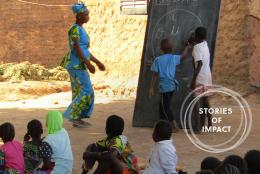
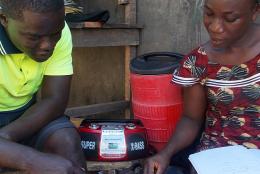
For the third time in as many years, the Bush administration has visited an EDC program overseas. In June, during her multi-nation trip to Africa, First Lady Laura Bush visited two EDC projects, meeting with students and teachers who use EDC radio programs for basic education, life skills, HIV/AIDS prevention, and teacher training. Mrs. Bush, accompanied by her daughter, Jenna, visited schools in Zambia and Mali that use the EDC-created programs. The work is funded by USAID through President Bush’s Africa Education Initiative.
-
Youth who have survived a natural disaster often have insights that can help their communities prepare for future crises. International agencies recently tapped that knowledge, turning to survivors of the tsunami in Indonesia, an earthquake in Pakistan, and others who had encountered near-death situations or witnessed severe damage to their communities.
-
Unemployment and HIV and AIDS have converged in Africa to create economic and social havoc. The population of young people 15–24 is growing, jobs are scarce, and HIV and AIDS are rampant.
-
In the wake of renewed calls to reduce the age to 18, the U.S. Department of Education’s Higher Education Center for Alcoholand Other Drug Abuse and Violence Prevention, located at EDC, has developed a fact sheet and resource bank.
-
Preschoolers in West Virginia are reaping the benefits of an EDC program that offers professional development and mentoring to their teachers.
-
Since 2005, the Massachusetts Early Intervention Training Center at EDC has supported early intervention specialists through training, mentoring,and Web resources.
-
For the thousands of foreign workers employed as domestics in countries around the world, jobs often carry unanticipated dangers. Recruited by international agents who promise lucrative jobs in exchange for a large fee, these workers often discoverthat legal protections from exploitation or abuse are all but nonexistent. With no recourse, some are forced into virtual slavery or resort to crime and prostitution to survive.
-
Have you ever wondered why a cake rises? How the bubbles get in the soda bottle? What makes a bathtub boat float or sink? If you answered “yes” to any of these, you’re in good company. Educators from around the country recently gathered at the Children’s Museum in Boston to investigate questions like these, part of a national initiative to bring high-quality, hands-on science to thousands of children in afterschool programs around the country.
-
Many Colombian parents must choose between sending their children to school and keeping them home to help support the family coffee-growing business. Many decide that school is not worth the cost in time and money. A recent EDC forum brought together corporate, public, and private representatives who identified a variety of innovative solutions.
-
Bogged down by rote-memorization drills and predictable homework exercises, EDC’s Al Cuoco was frustrated teaching math in the 1970’s. “Like many math teachers, I was always dissatisfied with most of the commercially available curricula I had.” Over the past five years, he has been working on behalf of today’s teachers “to create the texts I always yearned for.” As principal designer of a major mathematics textbook initiative, the CME Project, he says he is nearing his goal.
-
The last time Inez had a head cold, she reached for three different remedies—a nasal decongestant, something for her sore throat, and a syrup for her cough. In her quest for relief, she failed to notice that all three contained acetaminophen, and each featured a warning about the dangers of multiple doses of the drug.
-
At a community center in Bangkok, small-business owners are logging on to the Internet for the first time, using Microsoft Word, Excel spreadsheets, and other business software. These local entrepreneurs—including fruit sellers, garment makers, and artisans—are learning their technology skills courtesy of the multinational computer firm, Hewlett Packard (HP).
-
What does it take to turnaround an “underperforming” district? This question becomes more urgent every day as the number of districts earning this designation grows—and the consequences get tougher.
For EDC’s Barbara Miller, “turnaround partner” for the Winchendon (Massachusetts) Public Schools, the answer begins with some hard thinking about where an outside advisor like herself can have the biggest impact quickly.
-
With its emphasis on academic rigor and building skills in critical thinking, communications, and teamwork, it is no wonder that EDC’s interdisciplinary Ford Partnership for Advanced Studies (Ford PAS) high school program has drawn praise from the nation’s educators, the media, and government officials.
-
Most of us can remember that one adult—a teacher, parent, or neighbor—who made our transition from adolescence into adulthood a little easier. But for young people in the juvenile justice or foster care system, finding adults who can provide ongoing support and understand the unique challenges these youth face can be a difficult and sometimes impossible task. And while numerous agencies help connect young people to mentors, very few are equipped to assist these at-risk youth, leaving many without the guidance they so desperately need.
-
More than 50,000 foreign workers are employed as domestics in Bahrain today, yet they lack legal protection from exploitation or abuse. Instead, these workers—typically women and girls from Southeast Asia and Eastern Europe—rely on the protection of their employers or unscrupulous international agents who bring them into the country for profit.
-
Over the past 25 years, the number of school-age children in the U.S. who speak a language other than English at home has increased from 3.8 to 9.9 million. These students often lag behind their peers academically and schools are struggling to find ways to increase their level of achievement. The challenges in mathematics class are especially difficult.
-
At first glance, Jane Parfitt’s pre-K classroom at the Highland Park Child Care Center in Woonsocket, Rhode Island, looks like any good preschool classroom. There’s the writing center and book corner, the dramatic play area, the blocks, easels, and cubbies. There’s the alphabet strung on the wall, along with quilts and family pictures.
-
From dropout to vagrant to teen mother, 19-year-old Manoucheka Lizaire’s life quickly unraveled as she followed a path familiar to girls living in poverty. In Haiti alone, thousands of teens are like Manoucheka—out of school and living on the streets, in domestic servitude, or with families too poor to provide them with an education.
-
Wisdom “Laddo” Mulefu has become something of a hero at EDC. Depending on who you talk to, he’s the boy who traveled countless miles just to find a school that would enroll him … the boy who wouldn’t take “no” for an answer … the boy whose wholesale love of education blossomed before our very eyes.